Ep. 3: With My Pastor Dr Todd McCoy - Reading, Revival, Kirk, and More
Ep. 3: With My Pastor Dr Todd McCoy - Reading, Revival, Kirk, and More
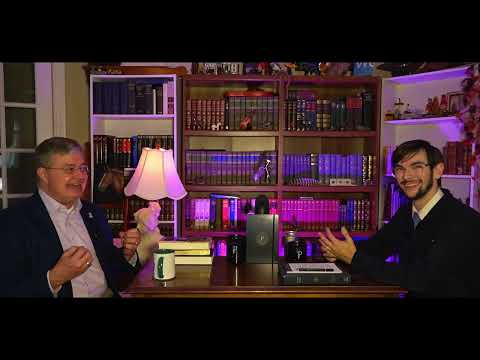
In this episode of Disciplined Disciple I'm joined by my pastor, Dr. Todd McCoy of the Associate Reformed Presbyterian Church of Greenwood, South Carolina, where he has served for a little over ten years. (We actually recorded this twice. I had a technical error the first time, and he graciously came back to redo it.) Here are some of the highlights.
Personal and corporate revival
We'd just finished our series Reformation and Revival, so I asked him to define the difference. Personal revival, he said, is an individual believer coming to a deeper awareness of his faith, hungering for the Word and taking up the disciplines that nourish faith: reading, meditating on, praying and even singing Scripture. It's first and foremost a work of the Holy Spirit, using the ordinary means of grace. Every believer goes through seasons where God feels distant, and then seasons of refreshment.
Corporate revival is when a body of believers experiences that together. He recommended Iain Murray's Revival and Revivalism, which shows that in true revivals ministers often did the same faithful work for 25 or 30 years, and then, inexplicably, people began hungering for the Word, for prayer and for fellowship. The only explanation was a move of the Spirit. That's very different from leaders trying to "pray down the Spirit" and make revival happen.
Is the resurgence of psalm-singing a result of revival or a cause of it? His "wonderfully firm answer, with both feet planted in midair": maybe both. He's hearing of younger people coming to churches hungry for the Word. If the church just stays faithful to the Word, we don't need to advertise it, jazz it up or add to it. It has its own power. And even if it isn't a nationwide revival, seeing a new generation come should be exciting for any Christian.
Reading and revival
In our series, I noticed lasting revivals repeatedly began among the young, and were often tied to reading. Pastor McCoy said the real danger is not reading. Murray's subtitle, The Making and Marring of American Evangelicalism, describes how in the 1800s revival turned into revivalism, driven by emotion: Finney's "anxious seat," the altar call that asks, "If you had an accident leaving the parking lot, where would you spend eternity?" Theology came to be seen as standing in the way of conversion. But in the First Great Awakening, people wanted to read more Scripture and more theology. He pointed to The Marrow of Modern Divinity, borrowed from a parishioner's shelf, which stirred a minister to proclaim the gospel freely to all, and is part of the roots of the ARP Church.
With thousands of books out there, how do you choose? Elders, he said, need to help people discern: "garbage in, garbage out." Point people to solid, challenging resources that illuminate Scripture faithfully, especially the confessions and catechisms, and to Christian writers across the centuries, so we're in conversation with those who came before us and don't reinvent the wheel every time the next star writes a book. The Reformers themselves went back to the church fathers.
Legalism, liberty and imagination
I told him about a Bible study I'd attended where fiction, even C. S. Lewis's Chronicles of Narnia, was ruled out, though Eustace's dragon scales being torn away by Aslan opened my eyes to the gospel. He said he understands the instinct to "circle the wagons" in a culture where everyone does what's right in his own eyes, but the circle keeps shrinking until you've kicked everyone out, including yourself.
Preaching through Acts 17, he pointed out that Paul reasoned from Scripture in the synagogue, but also went into the marketplace, engaged the philosophers, and even quoted their poets, all while presenting a pure gospel shaped by Scripture. If we refuse to engage the world around us, we lose the ability to share the gospel with our neighbors. "Look what we would lose without Lewis, without Tolkien," and by that logic, even The Pilgrim's Progress. God gave us imagination. But neither can we erase the boundaries so that grace means our actions don't matter. His illustration: a cell membrane lets in what gives life and keeps out what's toxic. Our membrane is the Word of God, our confessions, and the triune God we worship.
His own awakening
Pastor McCoy was first taken to church by his Baptist grandmother, then attended a PCUSA church with his Presbyterian grandmother (where he learned about community, but little theology), then an Episcopal church in college (liturgy and history, but still little theology). Then he met his wife, from a Reformed Presbyterian background, who put a copy of the Westminster Confession in his hands. At first God's decrees and total depravity "ticked him off," steeped as he was in Enlightenment ideas that people are basically good. But he looked up the Scripture references, she kept asking him what he believed and where it's in the Bible, and his faith truly awakened. He began reading, was asked to teach, had to study more, and found himself falling more and more in love with it, until he couldn't imagine doing anything other than ministry.
The sacraments and revival
I read him Thomas Watson's words that the Lord's Supper "revives their hopes." He was careful: baptism brings one into the church (it isn't the moment of salvation), and the Supper nourishes and strengthens faith that's already there. The Spirit certainly uses them to revive the soul. But we must be cautious about making Word, prayer or sacrament tools to drive revival. That's exactly how revival became revivalism. They're means the Spirit, already at work, uses to nurture the faith He's given.
So what can any of us do? The very things we can't use to manufacture revival are what nourish our hearts through every season: the ordinary means of grace, Scripture, prayer and the sacraments, and (he adds a fourth) fellowship, the mutual accountability and discipline of brothers and sisters. A church that doesn't exercise good discipline loses sight of the means of grace and starts looking for grace elsewhere.
The assassination of Charlie Kirk
We recorded a couple of weeks after Charlie Kirk was assassinated. Will it spark an awakening? Pastor McCoy said it's far too early to tell. After 9/11 the churches filled up for about three months and emptied just as fast. The recent campus prayer revival drew busloads of people, but he hasn't seen a lasting change from it. He isn't convinced Kirk was killed for his faith so much as for his ideology, though that ideology was shaped by his faith.
What will he do? The same thing he does every Sunday: proclaim the Word of God, applying it to current events, but not letting current events drive the message. The church, he joked, may be one of the most mismanaged organizations on earth, yet it survives where kingdoms and corporations fall, because it's Christ's church.
I mentioned the two extremes I've seen, rage and fear, and read Maurice Roberts in The Thought of God: panic is the sinful failure to apply our knowledge of God to particular problems. His middle ground was two words: Christ reigns. Be angry at unrighteousness, but there's no need to panic. He's less concerned now with the survival of the nation than with the health of the church. I also mentioned the contrast at the memorial between Erika Kirk publicly forgiving her husband's killer and the President's remarks about hating his enemies, and read Psalm 9: "The LORD sits enthroned forever... a stronghold for the oppressed, a stronghold in times of trouble."
He's wary of turning Kirk into a Christian martyr or merging the church with any political ideology. We shouldn't become "a new breed of crusaders, but a new generation of evangelists." The church shouldn't be a middle way between two ideologies; it should be the Way, the Truth and the Life. On the chant "We are all Charlie," he suspected Kirk himself would be mortified to be made a political saint. He wanted students to think for themselves and question what they were being taught. If people want to honor his memory, they should be critical thinkers.
How can you know God's will?
"An easy one," I said. He laughed: it's one he still struggles with daily. For him, knowing God's will has been a process, not a moment. God's sovereignty gives comfort in the present; His providence, seen looking back, gives hope for the future. "A man's heart plans his way, but the LORD directs his steps" (Proverbs 16:9). It comes back to the ordinary means of grace: being in the Word, in prayer and in worship daily. God asks us to discern His will so that our faith will grow. Lately John the Baptist's words keep coming back to him: "He must increase, but I must decrease."
He shared how he longed to leave the PCUSA for a church that believed the Word, reached out to the PCA, OPC and ARP with no result, and within two weeks of giving up, received a letter from the ARP church he now serves. Discerning God's will may begin in your own heart, he said, but it should be confirmed by your spouse, your family, your elders and those who walk with you. Red flags should go up when someone says, "I heard God say." And his favorite illustration: when the phone hung on the wall, you didn't know who was calling until you picked up and recognized the voice. The more we're in God's Word, the better we recognize His voice in the events of life.
Thank you again, Pastor McCoy. If you'd like to reach him, you can find him on Facebook or through the Greenwood ARP church website.
Soli Deo Gloria!