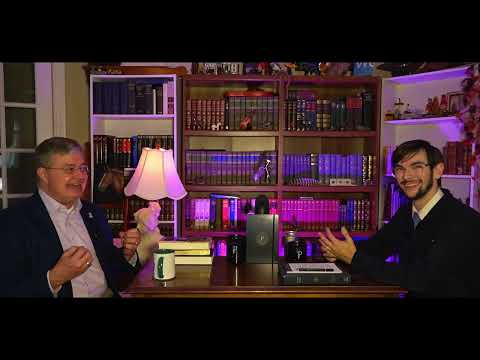
D.D. ep. 2: Worshiptainment, College, Sanctification, and Personal Struggle With Matthew Everhard
It was a great privilege to have Dr. Matthew Everhard on Disciplined Disciple. He's been an influence and inspiration to me for the last four or five years. Dr. Everhard is pastor of Gospel Fellowship PCA, just north of Pittsburgh, and an adjunct professor at Reformed Presbyterian Theological Seminary (RPTS). Here are some highlights.
Worshiptainment
His new book, Worshiptainment: The Modern Church's Golden Calf, critiques what he calls "worshiptainment," the blending of Christian worship with entertainment practices drawn from the secular world (Hollywood, Nashville, Broadway). The danger, as the subtitle suggests, is that it ultimately glorifies, or at least entertains, man rather than God. He wrote it in the summer of 2024: up a little earlier, at work a little later, a couple of paragraphs every day. He chose worship because it's the main thing we do as Christians; we were made to glorify God and enjoy Him forever.
How does this affect sanctification? Much of today's worship is designed to attract unbelievers and pacify immature Christians. But believers maturing in Christ tend to crave deeper, more biblical worship, which often sends them back through church history to recover practices like expository preaching and psalm-singing. Practically every generation of believers sang the Psalms until recent ones dropped them.
Preaching and the Psalms
How can a church bring those back without whiplash? Start with preaching, since it lays the foundation. Every Christian should be moving through the Bible in three ways: personal reading, family worship, and the Lord's Day. Expository preaching through whole books of the Bible gives the full range of Scripture (law, creation, judgment, the wrath of God, grace, repentance, faith), whereas a pastor who picks texts will choose by his own or the congregation's preferences, and only the "happy passages." Too many churches have reduced worship to what he calls "the concert and the TED Talk."
For psalm-singing, he recommends The Book of Psalms for Worship (Crown & Covenant), which translates the Psalms, puts them in meter and rhyme, and sets them to familiar tunes, so you're singing the very words of Scripture. His church sings a psalm of the week. (I've been working through the Trinity Psalter Hymnal since 2023, and he recommends it too.)
Family worship
We've been in the series What Happened to Manhood?, where family worship comes up in nearly every book. His advice to the head of the household: keep it simple, so it isn't intimidating and becomes a natural part of your routine. For the Everhards it's right after dinner. If it's too complicated, you'll talk yourself out of it ("we're too busy," "soccer practice"). They read one paragraph of a book of the Bible (right now Matthew), discuss it with age-appropriate questions for whoever's at the table, even guests, so no one's embarrassed, take prayer requests, and he prays. About ten minutes. Some families sing, too.
Having children
I asked, in light of Joel Beeke's Friends and Lovers, what he'd say to married couples who could have children but choose not to. Life is complicated, and there can be medical reasons and different seasons. But if you can have children, he believes you should. "Be fruitful and multiply" is one of the first commands in Scripture, and raising children in the fear and admonition of the Lord carries on the Great Commission. He'd discourage avoiding children for financial or lifestyle reasons: if you wait until you have the money, you'll never do it. There's something joyful about marrying young and starting a family, trusting the Lord and watching Him work.
A "dead mentor"
He chose Jonathan Edwards on John Piper's advice that every believer should have a "dead mentor." He was stressed, burned out and overwhelmed with fears, and Edwards writes everywhere about joy and Christian happiness, so his doctoral dissertation was on Edwards's theology of joy. With more than 20 volumes of works, Edwards is a lifelong pursuit, and he was a pastor, missionary, college president and philosopher.
He turned the question back to me. Mine is J. C. Ryle. My brother made me read Thoughts for Young Men, my life was forever changed, and I went on to read almost all of Ryle's works. Following Dr. Everhard's own advice for becoming a scholar of a theologian, I wrote an index to Ryle's Holiness, since none of Ryle's works have indexes.
His testimony and struggles
He grew up Lutheran, learning the creeds and the Trinity, but was saved through a revival sermon at a Pentecostal church, in one of those instantaneous conversions. He went straight home and shared the gospel with his sister. For a while he resented his upbringing and went through a non-denominational "no creed but Christ" phase. After a Quaker Bible college and a Brethren seminary, God led him to Reformed theology and Presbyterianism. Torn early on between missions and the pastorate, he did some mission work, but God led him to the local church. At 48, he'd just passed 25 years in full-time ministry.
His struggles change with the seasons. In youth, the lust of the flesh. Now, more often pride, vanity and ambition, along with caring for aging parents, children growing up, and thinking about legacy and health, including a serious bout of Lyme disease and the panic attacks that came with it. "Through many tribulations we must enter the kingdom of God" (Acts 14:22).
How does he fight sin? God gave him, by grace, a strong conscience and a great fear of His power. As a teenager in Ohio, his bedroom was beside the furnace, and seeing its fire terrified him, not because he doubted his salvation, but because he feared the Lord's judgment and chastisement. As a pastor, one of his greatest fears is dishonoring Christ's name or bringing his church into disrepute. There's no condemnation for those in Christ (Romans 8:1), but God does chasten those He loves. The stove burns so you'll take your hand off it.
Devotions: consistency without legalism
If he has one "superpower," it's consistency. He started reading the Bible daily in eighth grade, and the last day he missed was in 1997, at summer camp. Regular devotions mean you have to keep short accounts with God: it's awkward to sit down with someone you know is upset with you, and he has an appointment with the Lord at the breakfast table at 6 a.m. Desiring the Lord's favor matters as much as fearing His displeasure.
Legalism and antinomianism are like falling off either side of a trapeze: both are deadly. Legalism relies on our own merit or adds to God's law; antinomianism lives with no qualms of conscience. We walk the straight line between.
To avoid stagnation, he changes his devotional practice regularly, like cross-training: memory verses, reading quickly through the Bible, original languages, singing psalms. Right now he's translating Mark from Greek and writing out Genesis 3 in Hebrew. I admitted I tend to set a strict routine and then zone out, even reading aloud, even with The Valley of Vision. His suggestions: memory work, which forces your mind to engage, or writing prayer requests by hand with a strict word limit, as he once did (seven requests, two lines each).
Broadening your reading
There's nothing wrong with leaning into what you love, even becoming an expert in it. But try church history. It's theology run through people's successes and failures, with a real storyline. He can read twenty pages of church history before he tires, versus five of systematic theology. He explained the difference between biblical theology (following redemptive history) and systematic theology (topic by topic), and mentioned devotional, practical and homiletical writing. He's been reading Philip Schaff, too, and recommended John Piper's 21 Servants of Sovereign Joy, short, delightful biographies of about thirty pages each.
College and seminary
Most of my viewers are 18 to 22, so I asked about colleges. Locally he thinks well of Grove City and Geneva, and mentioned Liberty. But college isn't for everyone. His oldest daughter became a nurse through community college and earned over $80,000 in her first job, and his son is pursuing welding and heavy-equipment certifications. He also shared something few people know: some seminaries, including RPTS, have a route for students without a bachelor's degree, starting with certificate courses that transfer into the master's degree if you can handle seminary-level work. (Though if you're Presbyterian, he'd still recommend finishing any inexpensive bachelor's degree first, since presbyteries ordinarily expect one before ordination.)
Thank you, Dr. Everhard. And yes, his portrait is on my wall, between Ryle and Spurgeon, with his quote: "I have a beard because hair grows on my face."
Soli Deo Gloria!