Bible Doctrine by Wayne Grudem Review
I've been asked at least half a dozen times whether I'd review Wayne Grudem's Systematic Theology. My answer every time was that I had no intention of reading it. There are so many systematics I'd read before Grudem. But a college class had me read Bible Doctrine, which is basically an abridged version of his systematic, so that's what we're reviewing today.
The book and the author
It's 587 pages, 652 with confessions, a glossary and indexes. It's a glued hardcover, nothing extravagant, but printed in the USA, and I always appreciate that.
Wayne Grudem was born on February 11, 1948, and was 75 when I recorded this. He serves as professor of theology and biblical studies at Phoenix Seminary. His Systematic Theology has been read by thousands upon thousands, maybe into the millions. He played a huge role in the translation of the ESV, which I use daily, and was general editor of the ESV Study Bible, a great single-volume commentary. He grew up attending First Baptist Church in Wisconsin and continued in the Baptist faith, though he received his doctorate of divinity from Westminster Theological Seminary. He married his wife Margaret in 1969, and they have three children.
What's in it
An introduction to systematic theology, then seven parts: the doctrine of the Word of God, the doctrine of God, the doctrine of man, the doctrine of Christ, the application of redemption, the doctrine of the church and the doctrine of the future.
The appendix of "historic confessions of faith" surprised me. I hoped to find the Westminster Confession. Instead it has the Apostles' Creed, the Nicene Creed, the Chalcedonian Creed and the Chicago Statement on Biblical Inerrancy, which I just thought was a strange choice. There's also a glossary, an annotated bibliography of evangelical systematic theologies (a helpful section), and indexes.
I want to be fair. I came to this book already not liking Grudem, so I had to watch myself and take the book as the book was.
The good
- Review questions at the end of every chapter. Berkhof does this too, but Grudem's are catered to new theologians. They're simple, and they help you see what was important in the chapter.
- Questions for personal application. Most of the time these are helpful, though they can be a crutch. If you understand a doctrine and love it, you'll apply it.
- Special terms at the end of each chapter to see if you can define them. He gives the best definitions of words, always italicized so they're easy to find. I'd write "def" in the margin beside each one.
- Scripture memory for every chapter: one text you can take to heart that relates to the doctrine you just read.
Are there better books on this topic?
Definitely. The list is basically infinite: Berkhof, Frame, Hodge, Calvin, Beeke, Turretin, and it goes on and on. I'd read those first.
Would I buy it?
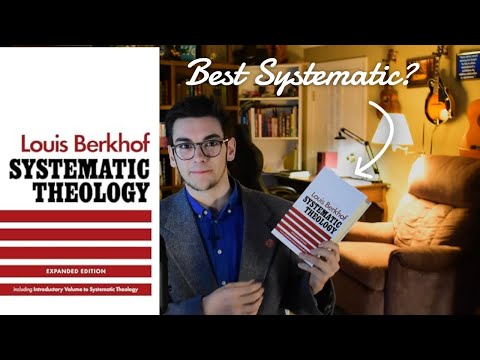
No. There's nothing inherently wrong with the book, but these aren't cheap books, and there are better ways to spend your money and time. The one advantage is that it's a single volume, but there are single-volume systematics all over the place. I love Berkhof, and it's a much better systematic in my opinion.
Why I was avoiding Grudem
Grudem might be avoided. That's for your own conscience to decide. I'm not trying to bash him. These are just things I noticed.
1. No history. He doesn't give the history or philosophy of a doctrine. It's very modern: here's the Baptist view, here's the Pentecostal view, here's the Presbyterian view. Berkhof goes so in depth into the history that you wonder how it even matters, but it does, and he does it so well. Without it you're left thinking "this is just the way it is" instead of seeing why it is the way it is.
2. Evolution. I say this with nothing against my brothers and sisters who believe in evolution. It's not a salvific issue. But in his preface to the second edition, Grudem says he now finds the scientific evidence for an old earth and an old universe overwhelming, and so he now advocates an old-earth position. That contradicts his own definition on page one, where he says systematic theology answers the question of what the whole Bible teaches us today about any given topic. In a systematic theology, tell me what the Bible says. At that point it's as though science rules over the Bible, and that's contradictory.
3. Controversies. He has some strange teachings on the Trinity, complementarianism and several other things. It's not heresy, but again, there are better things to be reading.
4. Spiritual gifts. He's a continuationist, so his writing is very charismatic in its understanding of basically everything. I have a Pentecostal background, so it's very near to me, but I'm Presbyterian now, and I disagree.
5. Eschatology. He's premillennial. That's not the end of the world. I came from a premillennial background. But I want to be challenged on my eschatology. Berkhof is amillennial, Hodge is postmillennial, and reading the history of why people hold those positions is better than being told "here's the way it is."
I probably won't be reading his full systematic. This was enough Grudem for me for a lifetime, but I'm glad I made it through.
Soli Deo Gloria!