
The Pilgrim’s Progress by
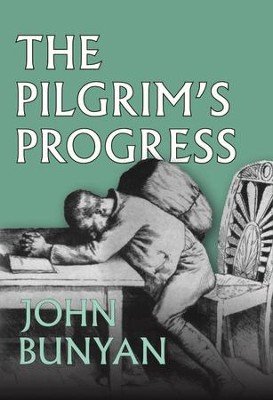
John Bunyan was born in 1628 at Elstow, near Bedford, to Thomas Bunyan and Margaret Bentley. His father was a tinker and was poor, but didn’t starve. With this in mind, Bunyan was not well-educated. While a teenager, Bunyan became quite rebellious, frequently swearing. As he wrote later in life, “It was my delight to be taken captive by the devil at his will: being filled with all unrighteousness that from a child I had but few equals, both for cursing, swearing, lying, and blaspheming the holy Name of God” (The Works of Bunyan, Vol I, p 6).
Bunyan went through seasons of great conviction, however, which restrained him from the majority of that rebellion. When Bunyan was sixteen, his mother and sister both passed away a month apart. While his father recovered quickly, remarrying a month later, Bunyan joined Cronwell’s New Model Army, where he continued to follow his rebellious tendencies. Though it was in the civil war that he was greatly softened. He came many times near to death, but the Lord in His providence spared him.
He left the army in 1646 or –7, and in 1648 he married a God-fearing woman whose name remains unknown, who owned nothing more than two books. Those two books, however, when Bunyan read them, greatly convicted him of his sin. He began attending church, stopped his swearing, and began trying to honour the Sabbath. He later began speaking to congregants, who taught him about Christ, and he greatly desired the joy that Christ brings in a soul. “I cannot now express with what longings and breakings in my soul I cried to Christ to call me,” he said.
Later, in 1651, he was introduced to John Gifford, the local pastor. God used Gifford to lead Bunyan to repentance and faith. Bunyan’s conversion story can be fully found in his book Grace Abounding. One of the biggest years in Bunyan’s life was 1655, when he moved to Bedford with his wife and four children under the age of six. He became a member at Gifford’s church and soon became a deacon. Word of his testimony quickly spread through the town, and several people were led to conversion in response to it. But by the end of the year, the pastor passed away. And so, in 1655, Bunyan began to preach. Hundreds of people came to hear him preach.
The next year, he published his first book, and two years later he published another one. In 1661, while preaching in a farmhouse, Bunyan was arrested for preaching without official rights from the king. When they told him he would only be freed if he would swear to stop preaching, he wittingly responded, “If I am freed today, I will preach tomorrow.” He was thrown into prison, where he wrote an insane amount of material, and made shoelaces to provide some income for twelve and a half years, from 1661-1672. It was in prison that he wrote the famous book The Pilgrim’s Progress.
That book sold more than 100,000 copies within the first decade of its publication, and has since been reprinted at least 1500 times and translated into more than 200 languages, with Dutch, French, and Welsh all appearing within Bunyan’s lifetime. It is known now as one of the most-sold books ever written. It is a fantastic book, allegorically teaching the story of the Christian life, or as Joel Beeke described it, “This is a moving allegorical account of spiritual warfare experienced by a wayfaring pilgrim travelling from the City of Destruction to the Celestial City, in which Bunyan allegorises his own religious experience as a guide for others . . . regeneration, faith, repentance, justification, mortification, sanctification, and perseverance are poignantly painted for us in biblical, doctrinal, experiential, and practical detail” (MTP 111). Or as Peter Toon puts it, “One of the great values of this book is that it declares very clearly that the Christian life, though lived on earth, must be directed heavenward to be authentically Christ-centred. For the narrow way leads in only one direction – to Christ in heaven” (Spiritual Companions 50). This book is a perfect representation of the trajectory of sanctification. “I must venture; to go back is nothing but death; to go forward is fear of death, and life everlasting beyond it: I will yet go forward” (Pilgram’s Progress, p. 44).
This book is, of course, available in many different editions, but the author’s favorite is by Banner of Truth.